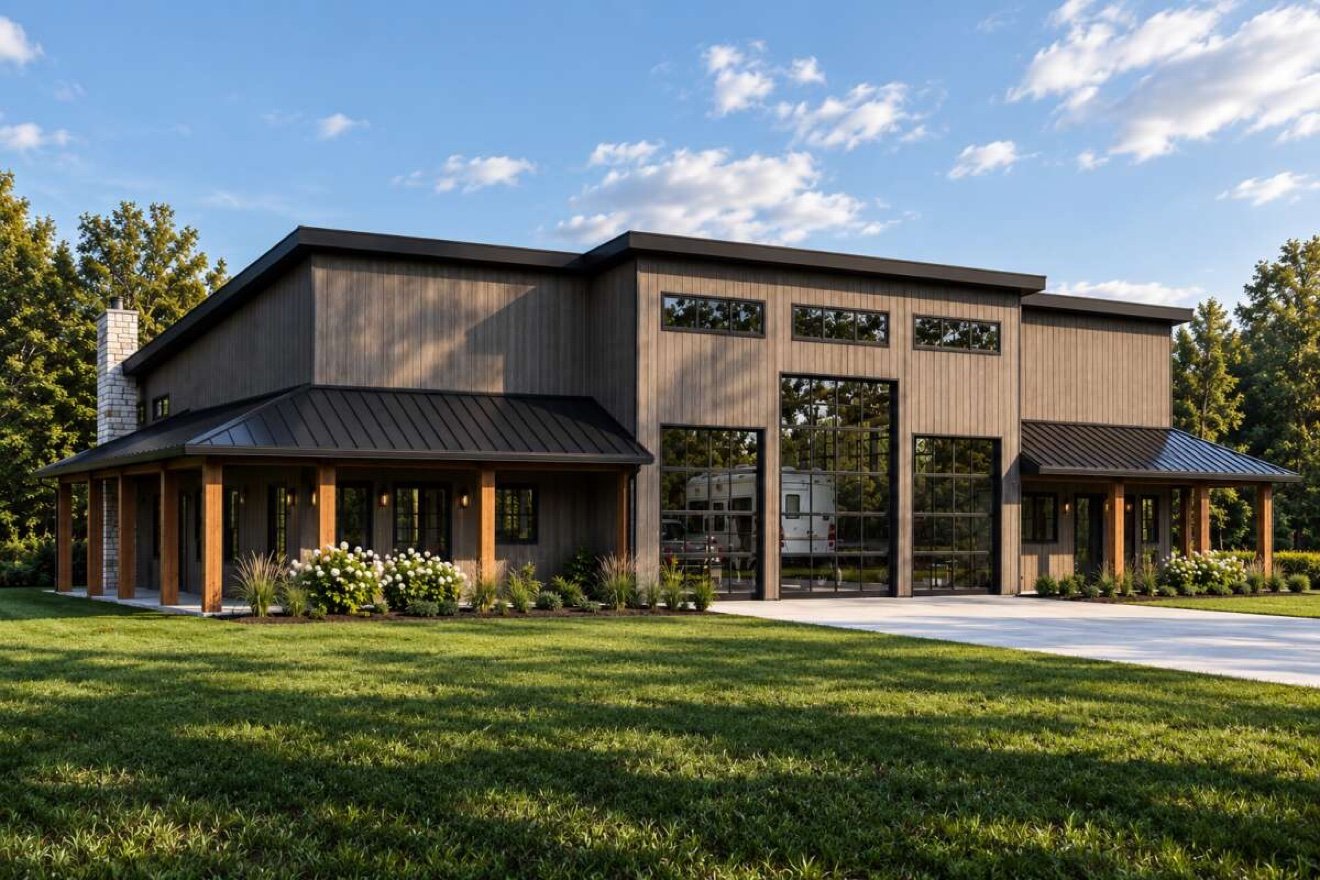
Why banks say no to barndos (and what to do about it)
Here's the wall most barndo buyers hit: many traditional banks simply won't finance metal-building homes. A barndominium doesn't fit the standard appraisal box — comparable sales are scarce, the construction is steel instead of stick-built, and half the value sits in a shop. Underwriters who do production mortgages all day look at that file and pass, not because the project is bad, but because their program was never built for it.
That's the gap a purpose-built barndominium financing program fills. Instead of forcing your build through a conventional purchase loan — or worse, a short-term construction loan you'll have to refinance out of — the financing is structured as construction-to-permanent from day one, designed around custom metal builds, shops with living quarters, and barn-style homes. Knowing how to finance a barndominium mostly means knowing this product exists before a bank talks you out of your project.
The down payment tiers
| Project amount | Max financing | Down payment |
|---|---|---|
| Up to $1,000,000 | 95% | 5% |
| $1,000,001 – $1,500,000 | 90% | 10% |
| $1,500,001 – $3,000,000 | 80% | 20% |
When financing is over 80% of the value, PMI and escrow are required — that's the tradeoff for putting 5% down instead of 20%, and it's stated up front, not buried. Program guidelines are subject to change; the figures here are a program overview, and final terms are determined in underwriting.
How one-time-close financing works, step by step
Six steps from first call to front door. The big idea: everything is approved and closed before construction starts, so the build itself is the only variable.
Application & pre-qualification
We review your income, credit, budget, and land situation, and map the project against the tiers above so you know your real numbers before you spend money on plans.
Builder approval
Your builder gets approved for the program — typically in 24–48 hours — and once a builder is approved, they stay approved. Bring the builder you already trust.
Plans, specs & appraisal
Your plans, specs, and build contract are documented and the project is appraised on its completed value, so the land, build, and budget all tie together in one file.
One closing
You close once — on a loan that covers the land (if you're buying it), the construction, and the permanent mortgage. Then your builder breaks ground.
Draws during the build
Over a construction period of up to 12 months, funds release in stages as work is completed. You pay interest only on what's been drawn, at your permanent rate.
Conversion & move-in
At 100% complete, the loan converts immediately to permanent financing — with a rate float-down option at conversion. No re-qualifying, no second closing.
Draw schedules, explained like a human
A draw schedule is just the plan for how construction money gets released. Your builder isn't handed the full loan amount on day one — nobody sane does that. Instead, the loan funds in stages, called draws, tied to completed work: the foundation draw after the slab is in, a framing draw when the structure is up, and so on through completion. Each draw matches progress you can see standing on your own lot.
Here's the part that matters: on a lot of construction programs, the lender dictates a rigid draw template that fits the bank's process, not the build. On this program, your builder creates their own draw schedule — matched to how they actually sequence and bill the work. That flexibility is a big reason builds run smoother: the money moves when the work does, not when a template says it should.
Interest-only during the build — what that really means
During construction you don't make full mortgage payments. You pay interest only, and only on the amount actually drawn so far, at your permanent loan's rate. Early in the build, when only the land and foundation draws are out, the payment is small. It grows gradually as more of the loan funds — and the construction period of up to 12 months is not counted against your permanent loan term. Full principal-and-interest payments begin when the loan converts at completion. For most buyers, that ramp is what makes carrying a build financially survivable — especially if you're paying rent or another mortgage while you wait.
One-time close vs. the two-loan route
The alternative to one-time close is the old way: a standalone construction loan now, then a brand-new mortgage to pay it off later. Here's the honest comparison:
| One-time close (this program) | Two loans, two closings | |
|---|---|---|
| Applications | One — approved up front | Two — you qualify all over again at completion |
| Closings | One, before construction starts | Two — a second set of closing costs later |
| During the build | Interest only on drawn amounts, at your permanent rate | Interest on the construction loan, terms vary by lender |
| At completion | Loan converts automatically, with a float-down option | New mortgage must be approved — job, credit, and rate changes can all hurt you |
| The risk | Locked in from day one | If anything changes during the build, your permanent financing isn't guaranteed |
The two-loan route isn't evil — it's just exposure. A year is a long time to bet that your income, credit, and the rate market will all cooperate at the exact moment your builder finishes. One-time close removes that bet.
Who this is for (and the one rule that matters)
This program is built for people building a primary-residence barndominium, shop house, or barn-style custom home — whether you're buying land and building in one motion, building on land you already own, or bringing your own builder to the table. Projects run up to $3,000,000, and I lend in 49 states, so the barndo in your head is financeable almost anywhere in the country.
The one rule with no exceptions: primary residence only. No vacation barndos, no investment properties, no rental builds on this program. If the home is the one you're going to live in, you're exactly who it was made for. Ready to run your numbers? The barndominium financing page has the full program, or start the form on this page and I'll map your project personally.
Not building yet? The lot loan comes first
If your timeline is "land now, build later," don't force a construction loan yet. A lot loan finances up to 80% of the lot — up to 10 acres with intent to build — on a 10-year fixed term or a 15-year term with a 20-year payment (balloon). It takes a 680 minimum credit score, and your down payment can come from a gift. Buy the dirt while it's available, then structure the one-time-close construction loan around your lot when you're ready. Both paths live on the BarndoMortgages.com home page — pick "Lot loan" or "Both" on the form and I'll sort out which one fits your timeline.
Barndominium loan questions, answered
What exactly is a barndominium loan?
A barndominium loan is a construction-to-permanent loan designed for barndominiums, shophouses, and barn-style metal homes. One application and one closing cover the land (if you're buying it), the construction, and your permanent mortgage — instead of a separate construction loan now and a second mortgage later. It's built for primary residences, on projects up to $3,000,000.
How does one-time-close construction financing work?
You apply once and close once, before construction starts. During the build — a construction period of up to 12 months, not counted against your permanent loan term — funds are released to your builder in stages as work is completed, and you pay interest only on the amount drawn, at your permanent rate. When the home is 100% complete, the loan converts immediately to permanent financing, with a rate float-down option at conversion. No second application, no second closing.
How much do I need for a down payment on a barndo?
Financing runs up to 95% of the project on builds up to $1,000,000 — as little as 5% down. From $1,000,001 to $1,500,000 it's up to 90% (10% down), and from $1,500,001 to $3,000,000 up to 80% (20% down). When financing is over 80% of the value, PMI and escrow are required. All loans subject to credit approval and program guidelines.
What is a draw schedule, and who sets it?
A draw schedule is the plan for releasing construction funds in stages as work is completed — foundation, framing, and so on. On this program, your builder creates their own draw schedule, matched to how they actually build, instead of a bank's template. Your builder does need to be approved first; approval typically takes 24–48 hours, and an approved builder stays approved.
Can I finance the land and the build together?
Yes. The lot can be purchased as part of the same one-time-close construction loan, or the loan can be structured around land you already own. Not ready to build yet? A separate lot loan finances up to 80% of the lot — up to 10 acres with intent to build — with a 680 minimum credit score and gift funds allowed for the down payment.
Can I use a barndominium loan for a vacation home or rental?
No. This program is for primary residences only — no vacation homes or investment properties. Justin Roth lends in 49 states, so a primary-residence barndo in most of the U.S. can be financed here, subject to credit approval and program guidelines.
Justin Roth
Liberty Federal Credit Union | NMLS #470586
I help buyers finance custom barndominiums and barn-style homes across 49 states — one-time-close construction loans, competitive financing options that fit your budget, and local expertise from someone you can trust. You'll talk to me, not a call center.
📞 (727) 415-9960✉️ jroth@libertyfcu.org
Your vision. Our expertise.
Let's build your future. Fill out the form at the top of this page and I'll personally review your land, budget, and builder — then map out your next step.
Get Pre-Qualified →